Character Editor#
The Character Editor defines the cast of your game — the playable characters you control
and the NPCs that populate your rooms. For each one you set its sprite, how it walks and
talks, how it casts a shadow, and (for NPCs) the ambient routines it follows when you're not
driving it. It saves to the project's characters.json.
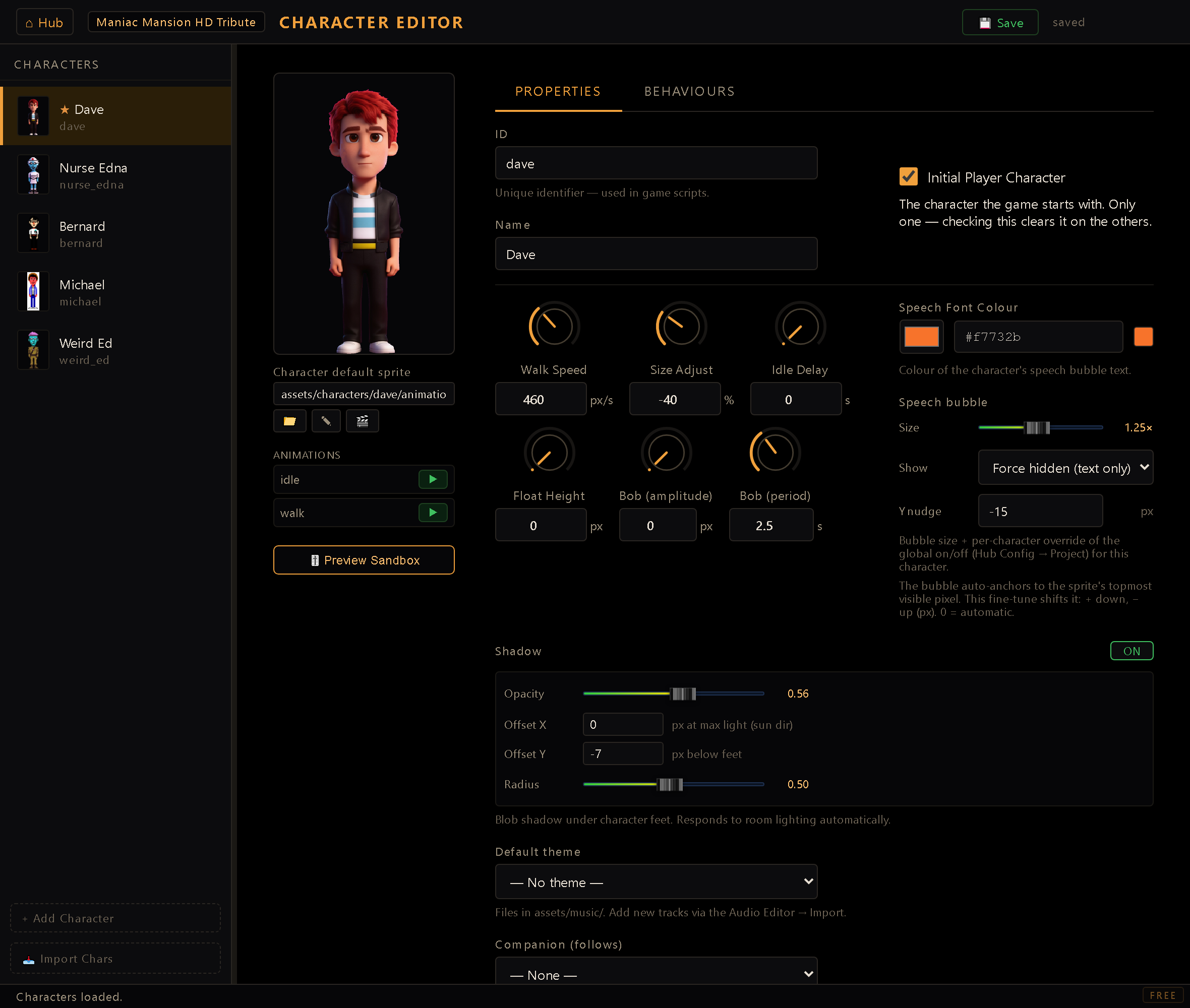
You reach it from the Hub (dev server running). Characters are listed on the left; + Add Character creates a new one, and selecting a character opens its detail panel. 📥 Import Chars bulk-creates a batch from a folder of PNG sprites — one PNG becomes one character (with the same defaults as + Add Character), after a review modal where you set each one's id.
Sprite & preview#
Each character points at a left-facing sprite (assets/sprites/…) via the path field or
the 📁 picker. The engine derives the other facings from it — right is mirrored, and the
animations/ folder beside the sprite supplies walk and idle clips. Click ▶ on any
animation in the list to play it right in the portrait — it cycles the four sides in turn and
runs at the clip's own speed, so the pace matches the game.
A row of buttons under the sprite's path field acts on that sprite: 📁 to pick a different one, ✎ to edit it, and 🎬 to send it into an animation.
✎ opens the sprite in the shared pixel-tweak modal — the same paint · scale · rotate · warp
workspace the Anim, Items and Cursor editors use — so you can fix a stray pixel or reshape the
art without leaving for an external editor; the preview refreshes on save. It carries a guard
specific to characters: if the sprite doesn't live in this character's own
assets/characters/<id>/ folder — because it's the shared default sprite, or one you reused
from another character's folder — editing it would change that art for every character
pointing at it, so the editor warns and asks you to confirm before opening.
🎬 turns the default sprite into animation material, which is usually how a character's first animation starts. You pick an animation and a direction, and the sprite is appended as that side's last frame — the editor suggests whichever side has the fewest frames so far.
The same dialog also offers + new animation, so you are never limited to the animations
the character already has: pick it and you name the new one (idle, walk, blink, or a name
of your own — only the names this character is still missing are suggested), seeded with the
sprite as a single frame on all four sides, the right side mirrored from the left, ready to open
in the Animations Editor. A character with nothing but a walk cycle gets its idle or its blink
the same way. If it has no animations at all yet, the button goes straight there.
Either way the sprite is copied into the animation's own file rather than referenced, so retouching that frame later never reaches back and changes the default sprite — or any other character sharing it. If the copy can't be made, nothing is appended and the default is left alone, rather than leaving you with a frame pointing at art that was never duplicated.
A 🎬 button beside the sprite sends the default sprite to one of this character's
animations. If the character already has animations, it opens a small picker (which animation,
which side — suggested as whichever side has the fewest frames) and appends the sprite as a
new frame there. If the character has none yet, it offers to seed one from scratch instead
of dead-ending: pick idle, walk, or a custom name, and it creates a looping animation with
the sprite as a single frame on all 4 sides (right mirrors left, per the project's
left-faces-left convention). Either way the sprite is copied into its own file under the
animation — tweaking it later in the Anim Editor never mutates the shared default.png.
Size preview sandbox#
🎚️ Preview sandbox opens a movable panel that answers what the portrait can't: how big is this character against the world, and against the rest of the cast? Pick a comparison character and both stand on the same floor — drag either one and their feet snap to a shared baseline so the comparison is honest (hold Alt to drag freely). With — blank floor — chosen the readout gives each one's on-screen height in pixels and the scale the walkable area applies where it's standing.
Pick a room instead and the panel composes the real game frame around them: the room clipped into its viewport (with camera sliders on rooms that scroll), FX, walk-behinds, parallax layers, light zones, hotspot art and the project's actual main GUI bar — the same composition the Room Editor sandbox draws, through the engine's own passes rather than a mock-up. Each of those is a toggle with an immediate repaint, and the readout switches to the room's dimensions, the project resolution and the GUI in play. This is where you check a size against the bar that eats the bottom of the screen, or against the walk-behind the character has to pass behind. Dragging is sandbox-local either way — it never writes a position anywhere.
Properties#
- ID — the character's stable key (
alex,bern…). It's what rules, inventories and effect tokens reference, so treat it as permanent; renaming it orphans anything that points at it. - Name — the display name shown in-game.
- Initial player — marks the character you start the game controlling. It's exclusive: ticking one clears it on every other character. Leave them all unticked and the engine falls back to the first character.
- Walk speed — a rotary knob setting movement speed directly in pixels per second
(
walkSpeed, 150–1050); double-click to reset to the 460 default. - Size adjust — a rotary knob, a percentage relative to the project's size class (−100…+400, double-click to reset to 0). The size class sets the baseline (a character is a fraction of the logical screen height); this nudges this character above or below it without re-authoring the sprite. At the very bottom of the range (−100) the character shrinks to about 1% of its class size and is effectively invisible on screen — the editor shows a warning label at that setting, both when you drag the knob there and when you load a character already saved at that value.
The range reaches +400 (×5) because low-resolution art in a high-resolution project needs
more than doubling: a 48px-tall sprite has to grow about 4× to occupy the quarter of the screen
a protagonist normally does. Past +150 (×2.5) a second label appears, naming the factor
you're at — that much enlargement softens the pixels, and the result that actually looks right
is re-authoring the sprite at the scale the project runs at. Pair the knob with the number box
beside it when you want an exact value: over a range that wide, typing beats dragging.
- Float height — a rotary knob (0–1000px, double-click to reset to 0) that lifts the
drawn sprite above the ground anchor without moving the character's actual position — for
floating/flying characters. The ground anchor still drives walkable bounds, depth sorting
and the cast shadow; only the sprite lifts.
- Idle delay — a rotary knob (0–10s) that holds the idle animation's first frame stock-
still for that long after the character settles, before its ambient idle fidget kicks in.
Zero means the fidget starts immediately; a couple of seconds makes a character feel calmer
and less twitchy when standing around.
- Speech color — the color of this character's spoken (SAY) text, set by picker or hex.
Walk speed, size adjust and speech color share one row.
- Theme — an optional per-character music theme, chosen from the project's audio ids.
- Shadow — toggle the cast shadow on/off and tune its opacity, offset X/Y and
radius.
- Speech bubble — a per-character size multiplier plus a show override
(inherit / on / off) that wins over the game-wide bubble setting. The bubble already
auto-anchors to the sprite's topmost visible pixel; a Y nudge knob fine-tunes that anchor
(+ moves it down, − up; 0 = fully automatic) for sprites whose art needs a little slack.
Behaviours (NPC routines)#
The Behaviours tab is where an NPC gets ambient routines — self-running step lists driven
by the core/behaviours.js sequencer. A character can hold several named behaviours; each
has its own id, and that's exactly what a BEHAVIOUR:<id> effect token starts (and
STOPBEHAVIOUR stops). Behaviour cards collapse to keep the list tidy, and ⧉ Duplicate
clones a whole behaviour — steps, loop and speed included — as a starting point for a variant.
Each behaviour is an ordered list of steps, in three kinds:
- go — walk somewhere: a hotspot, fixed coordinates, or its home spot, optionally in another room.
- wait — pause for N seconds.
- do — run a list of effect tokens (play an animation, say a line, set a flag — anything the effect system can do), with an optional hold afterward.
Reorder steps with ▲ / ▼, set the behaviour to loop, and optionally give it a speed override (a walk-speed knob just for this routine). When the NPC is on-screen it walks the steps with real pathfinding; off-screen the same routine resolves as an abstract travel timer, so the world keeps moving without rendering it.
Workflow#
- + Add Character and give it a stable ID and Name.
- Point it at its left-facing sprite, and check the animation preview with ▶.
- Tune walk speed, size adjust, speech color, shadow and bubble.
- Tick Initial player on the one the game starts with.
- For an NPC, add an ambient routine under the Behaviours tab.
- Save to write
characters.json.
The ID is the contract. Rules, inventories and effect tokens (
SWITCHCHAR,GIVEITEM:<item>|<character>,FOLLOW…) all reference a character by its ID. Pick it once and leave it — renaming breaks every reference, exactly like verb IDs and hotspot keys.